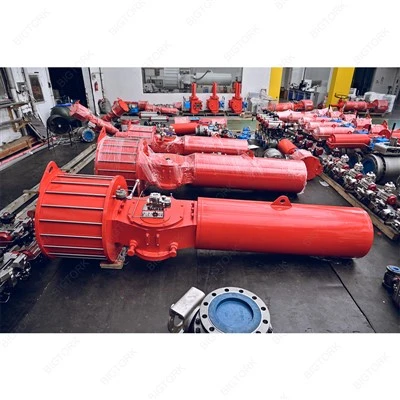
Hey there! As an air actuator supplier, I often get asked about how to calculate the force required for an air actuator. It's a crucial question, especially for those looking to use these actuators in various applications. In this blog, I'll break down the process step by step to help you understand how to figure out that all - important force.
Understanding Air Actuators First
Before we dive into the calculations, let's quickly go over what air actuators are. They're devices that convert compressed air energy into mechanical motion. There are different types, like linear and rotary actuators. Linear actuators move in a straight line, while rotary ones rotate. We offer a wide range of actuators, including the Heavy Duty Rotary Actuator and the Heavy Duty Actuator which are really popular due to their durability and performance.
Factors Affecting the Force Required
The force required for an air actuator depends on several factors.
1. Load
The load is the first thing you need to consider. It's what the actuator has to move or control. For example, if you're using an actuator to open and close a valve, the valve's weight and the pressure it has to overcome are part of the load. A heavier load obviously needs more force to move.
2. Friction
Friction is another big factor. There's friction in the actuator itself, in the mechanism it's connected to, and sometimes in the environment. For instance, if the actuator is in a dirty or oily environment, the friction can increase significantly. You need to account for this extra resistance when calculating the force.
3. Pressure
The air pressure supplied to the actuator is directly related to the force it can generate. Higher air pressure generally means more force, but you also need to make sure the actuator can handle that pressure. Our P350 Double - Acting Scotch Yoke Actuator is designed to work efficiently under different pressure ranges.
Calculating the Force for a Linear Air Actuator
Let's start with linear air actuators. The basic formula to calculate the force is:
[F = P\times A]
Where:
- (F) is the force in Newtons (N)
- (P) is the air pressure in Pascals (Pa)
- (A) is the effective piston area in square meters ((m^{2}))
Most of the time, we get pressure values in pounds per square inch (psi) and area in square inches ((in^{2})). So, the formula becomes:
[F = P\times A]
Where (F) is in pounds (lb), (P) is in psi, and (A) is in (in^{2})
For example, if you have an air pressure of 80 psi and a piston with an area of 2 (in^{2}), the force is calculated as:
[F=80\times2 = 160\space lb]
But remember, this is the theoretical force. In real - world situations, you need to account for friction and other losses. You might need to increase this calculated force by a safety factor, usually around 1.2 - 1.5, to ensure the actuator can handle the load properly.
Calculating the Force for a Rotary Air Actuator
Rotary air actuators are a bit more complex. The torque ((T)) generated by a rotary actuator is what we're interested in, and then we can relate that to the force if we know the radius of the movement.
The formula for torque in a rotary actuator is:
[T = P\times V\times k]
Where:
- (T) is the torque in Newton - meters (N·m)
- (P) is the air pressure in Pascals (Pa)
- (V) is the volumetric displacement of the actuator in cubic meters ((m^{3}))
- (k) is a constant that depends on the actuator's design
If you're using imperial units, the torque formula becomes:
[T = P\times V\times k]
Where (T) is in inch - pounds (in·lb), (P) is in psi, and (V) is in cubic inches ((in^{3}))
Let's say you have an air pressure of 60 psi, a volumetric displacement of 5 (in^{3}), and a constant (k = 0.1). The torque is:
[T=60\times5\times0.1 = 30\space in\cdot lb]
Once you have the torque, if you want to find the force at a certain radius (r), you can use the formula (F=\frac{T}{r}) (where (F) is the force, (T) is the torque, and (r) is the radius).
Considering Different Types of Actuators
We also have Spring Return Actuator and Actuator Scotch Yoke in our product range. Spring return actuators have a spring that provides a return force when the air pressure is removed. When calculating the force for these actuators, you need to consider the force of the spring as well.
For a scotch - yoke actuator, the force and torque calculations are a bit more involved because of its unique mechanical design. The geometry of the scotch - yoke mechanism affects how the air pressure is converted into linear or rotary motion. But the basic principles of pressure, area, and displacement still apply.
Safety and Efficiency
When you're calculating the force required for an air actuator, safety is key. You should always add a safety factor to your calculations to account for unexpected loads, wear and tear, and changes in the operating environment. At the same time, you want to make sure the actuator is efficient. Using an actuator that's too powerful can waste energy and increase costs, while an under - powered actuator won't be able to do the job.


Conclusion
Calculating the force required for an air actuator might seem complicated at first, but by understanding the basic principles and the factors that affect the force, you can do it accurately. Whether you're working with linear or rotary actuators, always consider the load, friction, pressure, and the type of actuator.
If you're in the market for high - quality air actuators and need help with your force calculations or just have general questions, we're here to assist. We've got a wide selection of actuators that can meet your specific requirements. Don't hesitate to reach out to us for a consultation and to start the procurement process. We're looking forward to working with you!
References
- "Pneumatic Systems Handbook"
- Manufacturer's documentation for air actuators.