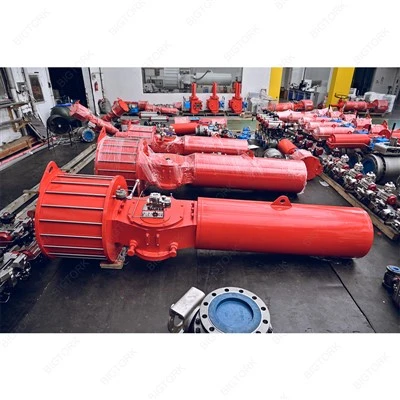
In the realm of industrial automation and control, air actuators play a pivotal role in converting compressed air energy into mechanical motion. As a seasoned supplier of air actuators, I've witnessed firsthand the diverse applications and the critical importance of selecting the right actuator size for optimal performance. In this blog post, I'll delve into how the size of an air actuator affects its performance, exploring various aspects such as force output, speed, response time, and energy efficiency.
Force Output
One of the most significant ways the size of an air actuator impacts its performance is through force output. The force generated by an air actuator is directly proportional to the pressure of the compressed air and the effective area of the piston or diaphragm. Larger actuators typically have a larger piston or diaphragm area, which means they can generate more force.
For example, in applications where heavy loads need to be moved or large valves need to be opened and closed, a Heavy Duty Actuator with a larger size is often required. These actuators are designed to handle high-pressure environments and can provide the substantial force necessary to perform the task. On the other hand, smaller actuators are suitable for applications where less force is needed, such as in precision control systems or in devices with light loads.
The relationship between actuator size and force output can be described by the following formula:
[F = P \times A]
where (F) is the force output, (P) is the air pressure, and (A) is the effective area of the piston or diaphragm. This formula clearly shows that increasing the area (A) (i.e., increasing the size of the actuator) will result in a higher force output, assuming the air pressure remains constant.
Speed and Response Time
The size of an air actuator also affects its speed and response time. Generally, smaller actuators tend to have a faster response time and can operate at higher speeds compared to larger ones. This is because smaller actuators have less mass to move and require less air volume to fill or exhaust the chamber.
In applications where rapid actuation is required, such as in high-speed manufacturing processes or in emergency shut-off systems, a smaller Air Torque Actuator may be the better choice. These actuators can quickly respond to control signals and move to the desired position, enabling efficient operation of the system.
However, it's important to note that the speed of an actuator is also limited by the air supply and the flow rate of the compressed air. If the air supply cannot provide enough air volume quickly enough, the actuator may not be able to reach its maximum speed, regardless of its size.
Energy Efficiency
Energy efficiency is another crucial factor to consider when evaluating the performance of an air actuator. Larger actuators generally consume more air and, therefore, more energy compared to smaller ones. This is because they require a larger volume of air to fill the chamber and move the piston or diaphragm.
In applications where energy consumption is a concern, such as in long-term continuous operation or in systems with limited air supply, selecting a smaller actuator can result in significant energy savings. Additionally, modern air actuators are designed with features such as efficient valve designs and low-friction materials to further improve energy efficiency.
For example, a Double Acting Actuator can be more energy-efficient than a single-acting actuator in certain applications. Double-acting actuators use compressed air to both extend and retract the piston, which can reduce the overall air consumption compared to single-acting actuators that rely on a spring or other means to return the piston to its original position.


Mounting and Space Requirements
The physical size of an air actuator also has implications for mounting and space requirements. Larger actuators may require more space for installation and may be more difficult to mount in tight spaces. In contrast, smaller actuators are more compact and can be easily integrated into systems with limited space.
When selecting an air actuator, it's essential to consider the available space and the mounting requirements of the application. For example, in some applications, a Spring Return Actuator may be preferred because it has a more compact design and can be easily mounted in a variety of orientations.
Compatibility with Other Components
The size of an air actuator can also affect its compatibility with other components in the system. For example, the size of the actuator may need to be matched with the size of the valve or other device it is controlling. If the actuator is too large or too small, it may not be able to properly interface with the other components, resulting in poor performance or even system failure.
In addition, the size of the actuator can impact the selection of other components such as air hoses, fittings, and valves. Larger actuators typically require larger air hoses and fittings to ensure adequate air flow, while smaller actuators can use smaller components, which can reduce the overall cost and complexity of the system.
Case Study: P350 Double-Acting Scotch Yoke Actuator
To illustrate the impact of actuator size on performance, let's consider the P350 Double-Acting Scotch Yoke Actuator. This actuator is designed for medium to large-scale applications where high torque and reliable performance are required.
The P350 actuator has a relatively large size, which allows it to generate a significant amount of torque. This makes it suitable for applications such as large valves in industrial pipelines or in heavy machinery. The double-acting design ensures that the actuator can provide force in both the opening and closing directions, providing precise control over the movement of the valve or other device.
However, due to its size, the P350 actuator may have a slower response time compared to smaller actuators. It also consumes more air and energy, which may be a consideration in applications where energy efficiency is a priority.
Conclusion
In conclusion, the size of an air actuator has a profound impact on its performance in terms of force output, speed, response time, energy efficiency, mounting requirements, and compatibility with other components. As a supplier of air actuators, it's our responsibility to help our customers select the right actuator size for their specific applications.
When choosing an air actuator, it's important to consider the requirements of the application, including the load to be moved, the speed and response time needed, the energy consumption, and the available space. By carefully evaluating these factors and selecting the appropriate actuator size, our customers can ensure optimal performance and reliability of their systems.
If you're in the market for an air actuator and need assistance in selecting the right size for your application, please don't hesitate to contact us. Our team of experts is ready to provide you with professional advice and support to help you make the best decision.
References
- "Pneumatic Actuators: Principles, Applications, and Selection," Industrial Press Inc.
- "Handbook of Pneumatic Actuators and Controls," McGraw-Hill Education.