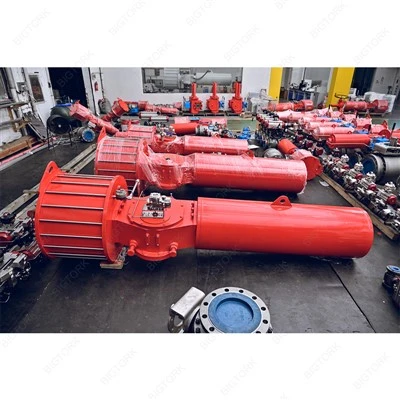
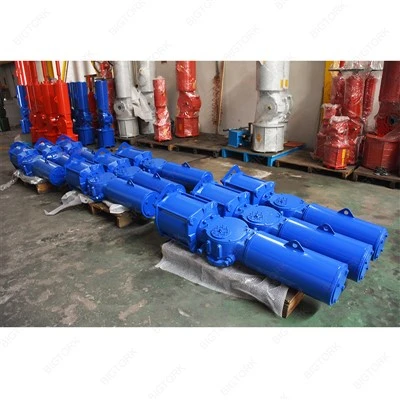
Zhejiang Bigtork Valve Automation Co., Ltd. is one of the leading manufacturers and suppliers of double acting actuator in China. As we have world-leading production equipment and strong manufacturing capabilities, we warmly welcome you to buy customized double acting actuator from our factory.
Company Profile
ZHEJIANG BIGTORK VALVE AUTOMATION CO,.LTD was located in famous pump and valve manufacturer base--Wenzhou City, China since founded by Mr zhang in 2006. Bigtork® take part in domestic and oversea gas and oil project in 2011, and now have a extensive experience in industry valve automation and flow control. Company has signed framement agreement with SINOPC and SNOOC as qualified Pneumatic Actuator supplier. Meanwhile, we are the reliable business partner of foreign world famous brand.
Why Choose Us?
Rich experience
BIGTORK not only focus on manufacturing Rotary & Linear and Pneumatic & Hydraulic valve actuator, but also offering one industry process control solution since founded by Mr zhang in 2006. We have 18+ extended production experience and 14+ extensive globle project undergo.
Strong R&D ability
Our team involves 6 engineers who owns domestic and oversea project work experience. We supply 100% technical support and problem solution for whole product life. Size selection tool that self owned software is avaivable for every clients.
Quality assurance
All series products strictly controlled with 9 processes by ISO and other system. The business partner of the raw material and components are profession major which supply for world renowned brand. A product warranty was provided with final testing and test report accordance with international product standards.
One stop service
Bigtork offer OEM & ODM services according to your requests from pre-sale to after-sale period. Each project has its own sale service tracking records. Each staffs is well trained to master proficient skill and full professional knowledge to support industry flow control one stop solution service.

An scotch yoke air actuator is a valve switch device can converts energy into compressed air into rotary mechanical motion to achieve the valve open and close.

BG series scotch yoke air torque actuator are designed in many different model number combinations of actuator sizes, cylinder diameters.

Scotch yoke air pressure actuators are designed for use over a wide range of pressures or temperatures.

The heavy duty actuator are available as pneumatic or hydraulic scotch yoke actuators for 90 degree angular valves, dampers or any device.

Valve actuator scotch yoke type are 90˚ driving mechanisms that can be powered by compressed air or hydraulic oil from an external source to converts linear motion of a bar sliding back and forth into a rotational motion.

A single acting actuator have either air or liquid supplied to one side of the piston, and the energy to move the valve comes from a spring on the opposite side.

The heavy duty rotary actuator are available as pneumatic or hydraulic scotch yoke actuators for 90 degree angular valves, dampers or any device.

BG series scotch yoke valve actuator adopts a modular product line design and is used to operate rotary stroke control valves such as switch type or frequently adjusted ball valves, butterfly valves, plug valves and etc.

BG series scotch yoke type actuator adopts a modular product line design and is used to operate rotary stroke control valves such as switch type or frequently adjusted ball valves, butterfly valves, plug valves and etc.
What is Double Acting Actuator?
A double acting actuator is a sophisticated device designed to operate valves by applying force in both opening and closing movements. Unlike their single acting counterparts, which use a spring to return to the original position, double acting actuators use power to move in both directions. This design enhances the control and responsiveness of the actuator, allowing for rapid, efficient operations.
Benefits of Double Acting Actuator
Enhanced control and flexibility:
Double acting pneumatic actuators offer precise control over the movement of valves or other mechanical devices. They allow for bidirectional operation, providing flexibility in both opening and closing applications. This feature enables precise regulation of fluid or gas flow, ensuring optimal process control.
Quick and responsive operation:
One of the notable advantages of double acting pneumatic actuators is their rapid response time. They facilitate fast actuation, allowing for efficient operation in time-critical processes. The immediate response ensures prompt adjustments, contributing to enhanced productivity and system performance.
Robust and reliable design:
Double acting pneumatic actuators are known for their durability and longevity. Constructed from high-quality materials, they exhibit excellent resistance to corrosion, wear, and harsh operating conditions. This robust design ensures reliable performance even in demanding industrial environments, reducing downtime and maintenance costs.
Energy efficiency
Double-acting pneumatic actuators operate on compressed air, which is a renewable and energy-efficient resource when appropriately managed. They can be easily controlled and monitored, reducing the energy needed to maintain desired movements and positions. Using double-acting actuators in automation can further optimize energy usage by matching air pressure and volume to the task requirements.
Scotch yoke pneumatic actuator:
The scotch yoke actuator is a variation of the linear actuator that uses a circular motion to create linear motion. It is often used in applications where a high torque is required at both ends of the valve travel. The design of this actuator allows the valve to move quickly between the open and closed positions, allowing for precise control of the fluid flow through the valve.
Helical pneumatic actuator:
The helical pneumatic actuator is a type of rotary actuator that converts the linear motion of a piston into a rotary motion through a helical gear mechanism. This mechanism allows for a smooth and consistent operation of the valve, resulting in accurate positioning and control of the fluid flow.
Rack and pinion pneumatic actuator:
The rack and pinion pneumatic actuator is a type of rotary actuator that uses a rack and pinion mechanism to convert the linear motion of a piston into a rotary motion. It is often used in applications that require quick response and high positioning accuracy. The simple design of this actuator allows for easy maintenance and reliable operation over time.
Diaphragm pneumatic actuator:
The diaphragm pneumatic actuator is a type of linear actuator that uses a flexible diaphragm to convert the energy of compressed air into mechanical motion. It is often used in applications that require a high level of cleanliness and reliability. The simple design of this actuator allows for easy installation and maintenance.
Application of Double Acting Actuator
Double-acting cylinders are often used in various sectors such as industry, automotive engineering, construction, and mechanical and plant engineering. In industry they are used to automate production lines, in the automotive industry to support windshield wipers and lift trunk lids, and in construction to raise and lower platforms, cranes and elevators.
Double-acting actuators offer high performance, precision and safety in many applications. Due to their versatility and flexibility, they are often chosen as an alternative to other types of actuators.
In machinery and equipment, double-acting cylinders are often used to raise and lower components such as tools, molds, stickers, etc. They are also widely used in automating processes such as sorting, packaging and picking products.
Dual-acting actuators are also commonly used in medical equipment such as surgical tables, sofas, and dental chairs. They are used to raise and lower elements and allow easy and precise adjustment of the patient's position during the procedure.
Overall, double-acting actuators are an essential tool in many industries as they offer high efficiency, precision and safety. Its wide range of applications proves its importance in many areas.
Use of double acting drives in industry and business
Double acting cylinders are used in a wide variety of industrial and economic areas and support many manufacturing processes. Many companies in the engineering, automotive and manufacturing sectors use double-acting actuators to automate their processes and increase their efficiency. Many manufacturing machines, such as machining machines, use double-acting cylinders to support their moving components and ensure smooth, precise operation.
Double acting cylinders are also used in many industries such as construction and infrastructure to support processes such as lifting and lowering structures such as bridges, buildings and hydraulic structures. In the automotive industry, double acting cylinders are often used to raise and lower machines and equipment such as elevators, cranes and platforms.
Cylinder
The cylinder is the main body of the actuator. It houses the piston and provides the space necessary for it to move back and forth. The cylinder's interior surface is polished to reduce friction and promote smooth movement of the piston.
Piston
Located inside the cylinder, the piston is a disc-shaped component that moves along the cylinder's length when pressure apply. The piston's movement directly controls the mechanical motion of the actuator.
Ports
There are two ports in a double acting pneumatic actuator, each named as per its function – the 'input' and the 'exhaust' port. The input port allows the entry of compressed air into the cylinder to drive the piston, while the exhaust port allows the air to escape.


End caps
End Caps are placed at both ends of the cylinder to prevent the escape of air. They also serve as mounting points for the ports and often contain guides to direct the motion of the piston rod.
Piston rod
The piston rod connect to the piston and extends through one end of the cylinder. The rod's movement is guided by the end cap and is directly linked to the actuator's output motion. When the piston moves, it drives the piston rod, causing the actuator to perform its mechanical action.
Regular inspection: Check whether the pneumatic actuator has air leakage, whether the connection part is loose, and whether the working status is normal. Timely repair or replacement of damaged parts.
Lubrication: Regularly add lubricating oil to the sliding parts and piston of the actuator to ensure smooth movement and reduce friction and wear.
Cleaning
Keep the surface of the actuator clean. Regularly remove dust and dirt to prevent debris from entering the inner part of the actuator and affecting its operation.
Air source treatment
Regularly drain the air compressor and filter the air source to prevent moisture and impurities from entering the actuator, which may cause damage.
Calibration
If the actuator is equipped with accessories such as positioners, it may need to be re-calibrated during maintenance to ensure accurate operation and control.
When to Use Spring-Return and Double-Acting Actuator?
Torque or thrust strength
Oil and gas operations along the coast are generally unaffected by the thrust or torque strength of the spring return and double-acting actuator.
Granted that some manufacturers claim that double-acting actuators are more advanced in terms of thrust or torque strength than spring return actuators, this distinction is limited to extremely high thrust or torque activities, which are rarely found in coastal applications. Thus, the thrust or torque strength of each is the same.
Safety integrated system application
In high-security system applications where the valve must remain open or unhindered in the event of a signal or supply loss, such as blow-down valves (BDV) and shutdown valves (SDV), the spring return is the recommended choice.
Because of its dependability and simplicity, the spring return type is the greatest option for safety operations. Although the initial panel configuration for double-acting actuators will be more complicated than that of spring return types, they are still an option for fail-close or open applications.
Fail in last position
Certain procedures, like the product choke valve, require the valve to be in the ultimate position when the signal or supply is lost. The default failure position of the choke valve is to fail last in order to preserve the prior output rate.
A double-acting actuator is the ideal choice if the last position is needed in the case of a failure. By applying pressure on both sides of the actuator, the valve is kept in place.
Control operation
For tiny valves up to 8 inches, the common actuator in a process control operation that uses a control valve as its ultimate control element is a diaphragm spring return diaphragm. To overcome the necessary high thrust, a double-acting type actuator is used when it is 10 inches or larger.
Even if the size is smaller than 10 inches, the double-acting actuator is still used when a substantial amount of push is needed to complete the action. For control operations, this double-acting actuator is stiffer and more stable, especially in situations where the process condition varies suddenly.
The thrust on the opposite side is always the same as the spring when using the diaphragm spring return type. A double-acting actuator allows the positioner pressure output to be adjusted.
The thrust on the opposite side is always the same as the spring when using the diaphragm spring return type. The positioner pressure output controls the opposite side forces based on the factual conditions when a double-acting actuator is used.
The defining characteristic between these two style actuators can be found in their names; a spring (single) actuator supplies power for one direction of its working range while the double actuator supplies power for both working directions. This is because the spring actuator utilizes spring force to move the valve position to either open or close. In contrast, the double acting actuator utilizes a piston element to operate that valve and thus will require pressurization on both of its sides.

Essential Tips for Choosing the Right Double Acting Pneumatic Actuator
Determine the required force and torque
The amount of force or torque an actuator must generate is critical to the proper sizing of the actuator. Calculate the required force based on the load the actuator is intended to move, friction and other factors that affect force transmission. Make sure that the selected actuator provides enough force without being oversized, as this can lead to inefficiency and increased costs.
Consider the operating pressure
Double-acting actuators operate within a specific pressure range, usually between 60 and 120 psi (pounds per square inch), but requirements vary depending on the application. Make sure your compressed air supply can maintain the pressure required to keep the actuator moving consistently. By choosing an actuator that is slightly above the required operating pressure, you can compensate for pressure fluctuations and ensure reliable performance.
Choose the right size and stroke length
The size and stroke length of the actuator should be matched to the space available in your system and the desired range of movement. The stroke length determines how far the actuator's piston moves, which directly affects the actuator's performance. Ensure that there is sufficient space in your system for the fully extended actuator, taking into account any obstructions or space restrictions.
Evaluate the type of mounting required
The mounting style plays a role in the actuator's functionality and installation. Common mounting options include foot or flange mounting, which is best for stationary applications, or clevis or trunnion mounting, suitable for applications requiring pivoting movement. Choose a mounting type compatible with the actuator and the machine or structure it will attach to for optimal alignment and motion control.
Material compatibility with the operating environment
Different environments demand different materials to withstand factors like moisture, dust, chemicals, or extreme temperatures. For example, stainless steel is ideal for corrosive environments or applications in food processing, chemical handling, or marine operations. It provides excellent resistance to rust and contamination.on the other hand, aluminum is lightweight and corrosion-resistant, making it suitable for most industrial applications. Selecting an actuator with materials compatible with the operating environment enhances longevity and reduces maintenance needs, ensuring reliable performance tailored to specific conditions.
Speed and control requirements
The speed of the actuator determines how fast the load moves. Some applications require fast movement, while others require slower, controlled movement. Speed controllers, such as flow control valves, can be added to regulate airflow and control actuator speed. If precise control is required, actuators with position sensors or feedback systems should be considered to allow accurate monitoring and control of movement.
Compatibility with safety and regulatory standards
In certain industries, there may be regulations governing the use of actuators, particularly in the food and pharmaceutical industries or in hazardous environments. Look for certifications such as ATEX for explosive environments or FDA compliance for food processing.
Bigtork® have covered an area of total 20000 square meters, which its workshop for machining, assemble, testing and its warehouse for raw material, semi-finished product and finished product.


Our Certificates


FAQ
Hot Tags: double acting actuator, China double acting actuator manufacturers, suppliers, factory, Double Acting Actuator, scotch yoke actuator, Scotch Yoke Type Actuator, Air Torque Actuator, Actuator Scotch Yoke, pneumatic actuator