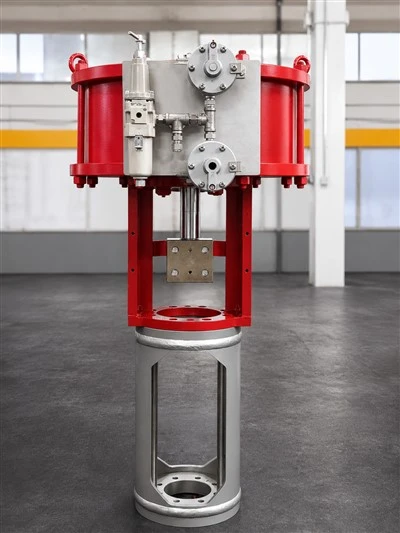
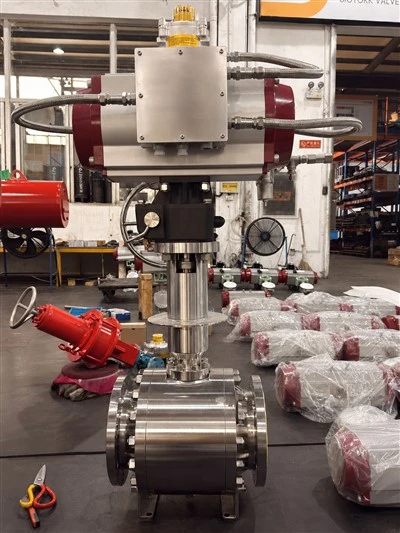
In the realm of industrial automation and machinery, heavy-duty actuators play a pivotal role in powering critical operations. As a seasoned heavy-duty actuator supplier, I've witnessed firsthand the diverse range of applications and the equally diverse requirements for communication interfaces. This blog post aims to delve into the various communication interfaces available for heavy-duty actuators, shedding light on their features, advantages, and ideal use cases.
Why Communication Interfaces Matter in Heavy-Duty Actuators
Heavy-duty actuators are often used in harsh industrial environments, controlling valves, dampers, and other machinery. Their operation can have a significant impact on the overall efficiency, safety, and productivity of a plant. Communication interfaces allow these actuators to interact with control systems, providing crucial data on their status, position, and performance, as well as allowing operators to send commands for precise control.
Common Communication Interfaces for Heavy-Duty Actuators
4 - 20 mA Current Loop
One of the most widely used communication interfaces in industrial applications is the 4 - 20 mA current loop. This analog interface is known for its simplicity, reliability, and immunity to electrical interference. In a 4 - 20 mA system, the actuator's position or other parameters are represented by a current signal ranging from 4 mA to 20 mA. A 4 mA signal typically represents the minimum value (e.g., fully closed valve), while 20 mA represents the maximum value (e.g., fully open valve).
The main advantage of the 4 - 20 mA interface is its long-distance transmission capability. It can carry signals over several hundred meters without significant signal degradation. Additionally, it is a well-established standard, making it compatible with a wide range of control systems and instruments.
Modbus
Modbus is a serial communication protocol that has become a de facto standard in the industrial automation industry. It is a master - slave protocol, where a master device (such as a programmable logic controller or a human - machine interface) sends requests to one or more slave devices (like heavy - duty actuators) and receives responses.
There are two main variants of Modbus: Modbus RTU and Modbus TCP. Modbus RTU is used for serial communication over RS - 485 or RS - 232 interfaces, while Modbus TCP is designed for Ethernet - based communication. Modbus allows for the exchange of multiple data points, such as actuator position, torque, temperature, and diagnostic information. It is easy to implement and offers a high degree of flexibility, making it suitable for a variety of heavy - duty actuator applications.
Profibus
Profibus is another popular industrial communication protocol, especially in European and Asian markets. It comes in two variants: Profibus DP (Decentralized Peripherals) and Profibus PA (Process Automation). Profibus DP is mainly used for high - speed communication between controllers and field devices, while Profibus PA is designed for intrinsic safety and is commonly used in process automation applications.
Profibus offers fast data transfer rates and supports a large number of devices on the same network. It provides real - time communication, which is crucial for applications where precise control and monitoring of heavy - duty actuators are required.
Ethernet/IP
Ethernet/IP (Industrial Protocol) is an Ethernet - based communication protocol that has gained significant traction in the industrial automation sector. It uses standard Ethernet hardware and TCP/IP protocols, making it easy to integrate with existing IT infrastructure. Ethernet/IP supports both discrete and analog data transfer, as well as messaging for configuration and diagnostic purposes.
One of the key advantages of Ethernet/IP is its high - speed data transfer capability. It can handle large amounts of data quickly, enabling real - time monitoring and control of heavy - duty actuators. Additionally, it is an open standard, which means that there are many compatible devices and software tools available in the market.
Specific Actuators and Their Communication Needs
Spring Return Actuator
A Spring Return Actuator is designed to return to a predefined position (usually the closed position) when the power fails or when the control signal is removed. These actuators are commonly used in safety - critical applications, such as emergency shut - off valves. For such applications, a reliable communication interface is essential to monitor the actuator's position and status at all times. Modbus or 4 - 20 mA interfaces are often preferred, as they provide a simple and robust way to transmit position data and diagnostic information to the control system.


Double Acting Actuator
Double Acting Actuators and Double Acting Actuators from the factory are powered in both directions of movement, allowing for precise control of the actuator's position. These actuators are commonly used in applications where continuous and accurate control is required, such as in the chemical and petrochemical industries. Ethernet/IP or Profibus interfaces are well - suited for double - acting actuators, as they can provide high - speed data transfer and support real - time control.
BG Series Scotch Yoke Actuator
The BG Series Scotch Yoke Actuator is known for its high torque output and reliability. These actuators are often used in large - scale industrial applications, such as power plants and refineries. Depending on the specific requirements of the application, different communication interfaces can be used. For applications where long - distance communication is required, 4 - 20 mA or Modbus RTU may be a good choice. For high - speed data transfer and integration with advanced control systems, Ethernet/IP or Profibus can be used.
Single Acting Actuator
Single Acting Actuators are powered in one direction of movement and rely on a spring or other external force to return to the original position. These actuators are commonly used in applications where simple and cost - effective control is required. A 4 - 20 mA interface is often sufficient for monitoring the actuator's position, while Modbus can be used for more advanced diagnostic and configuration purposes.
Choosing the Right Communication Interface
When choosing a communication interface for a heavy - duty actuator, several factors need to be considered:
- Application Requirements: The specific requirements of the application, such as the need for real - time control, long - distance communication, or integration with existing systems, will determine the most suitable communication interface.
- Compatibility: The interface should be compatible with the existing control system and other devices in the network. This ensures seamless integration and reliable operation.
- Cost: The cost of implementing the communication interface, including the cost of hardware, software, and installation, should be taken into account.
- Scalability: If there is a possibility of expanding the system in the future, the communication interface should be scalable to accommodate additional devices.
Conclusion
In conclusion, the choice of communication interface for a heavy - duty actuator depends on a variety of factors, including the application requirements, compatibility, cost, and scalability. As a heavy - duty actuator supplier, we understand the importance of providing our customers with the right communication solutions to ensure the optimal performance of their actuators. Whether you need a simple 4 - 20 mA interface for basic monitoring or a high - speed Ethernet/IP interface for real - time control, we have the expertise and products to meet your needs.
If you are interested in learning more about our heavy - duty actuators and the available communication interfaces, or if you have any specific requirements for your application, please feel free to contact us for a detailed discussion and procurement. We look forward to working with you to find the best solutions for your industrial automation needs.
References
- "Industrial Communication Networks: Principles and Applications" by Klaus Dieter Thoben, Oliver Niggemann, and Dragana Kovacevic.
- "Control Systems Engineering" by Norman S. Nise.