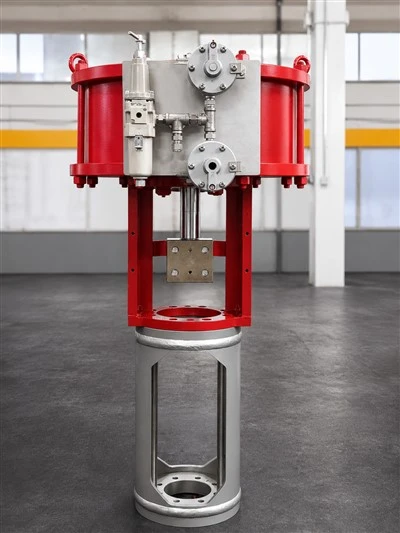
A pneumatic actuator is a device that converts energy from compressed air into mechanical motion. It is widely used in various industries for controlling the flow of fluids, opening and closing valves, and performing other automated tasks. As a pneumatic actuator supplier, I understand the importance of having the right accessories to ensure the efficient and reliable operation of these actuators. In this blog post, I will discuss some of the key accessories for pneumatic actuators.
Solenoid Valves
Solenoid valves are one of the most common accessories for pneumatic actuators. They are used to control the flow of compressed air to the actuator, allowing it to move in the desired direction. Solenoid valves work by using an electrical current to open or close a valve, which in turn controls the flow of air. There are two main types of solenoid valves: direct-acting and pilot-operated. Direct-acting solenoid valves are suitable for small actuators and low flow rates, while pilot-operated solenoid valves are better suited for larger actuators and higher flow rates.
When choosing a solenoid valve for a pneumatic actuator, it is important to consider factors such as the voltage, flow rate, and pressure rating. You can find a wide range of solenoid valves on our website that are compatible with different types of pneumatic actuators.
Position Sensors
Position sensors are used to detect the position of the actuator's piston or shaft. They provide feedback to the control system, allowing it to monitor the actuator's position and ensure that it is operating correctly. There are several types of position sensors, including proximity sensors, limit switches, and magnetic sensors.
Proximity sensors use electromagnetic fields to detect the presence of an object, such as the actuator's piston. Limit switches are mechanical switches that are activated when the actuator reaches a certain position. Magnetic sensors use magnets to detect the position of the actuator's piston or shaft. Position sensors are essential for applications where precise positioning is required, such as in automation systems.
Speed Controls
Speed controls are used to regulate the speed of the pneumatic actuator's movement. They allow you to adjust the rate at which the actuator extends or retracts, which can be important for applications where the speed of the operation needs to be controlled. There are two main types of speed controls: flow control valves and throttle valves.
Flow control valves regulate the flow of compressed air to the actuator, which in turn affects its speed. Throttle valves work by restricting the flow of air, thereby reducing the speed of the actuator. Speed controls can help to improve the efficiency and performance of the pneumatic actuator, especially in applications where smooth and controlled movement is required.
Mounting Brackets and Adapters
Mounting brackets and adapters are used to attach the pneumatic actuator to the equipment or structure where it will be used. They provide a secure and stable connection, ensuring that the actuator is properly aligned and can operate effectively. There are various types of mounting brackets and adapters available, depending on the type of actuator and the application requirements.
Some mounting brackets are designed to be compatible with specific types of valves or equipment, while others are more universal in nature. Adapters can be used to connect the actuator to different types of piping or fittings. When selecting mounting brackets and adapters, it is important to choose ones that are made of high-quality materials and are suitable for the operating conditions.
Air Filters, Regulators, and Lubricators (FRL Units)
Air filters, regulators, and lubricators, commonly referred to as FRL units, are essential accessories for pneumatic actuators. They are used to clean, regulate, and lubricate the compressed air that is supplied to the actuator.
Air filters remove contaminants such as dust, dirt, and moisture from the compressed air, which can damage the actuator and reduce its performance. Regulators control the pressure of the compressed air, ensuring that it is within the optimal range for the actuator. Lubricators add a small amount of lubricant to the compressed air, which helps to reduce friction and wear on the actuator's moving parts.
FRL units are typically installed in a pneumatic system upstream of the actuator to ensure that the air supplied to the actuator is clean, regulated, and lubricated. This helps to extend the lifespan of the actuator and improve its reliability. You can learn more about our FRL units on our website.
Emergency Shut-Off Valves
Emergency shut-off valves are safety devices that are used to quickly stop the operation of the pneumatic actuator in case of an emergency. They are typically installed in the pneumatic system and can be activated manually or automatically.
In the event of an emergency, such as a fire, a leak, or a malfunction, the emergency shut-off valve can be closed to cut off the supply of compressed air to the actuator, preventing it from causing further damage or danger. Emergency shut-off valves are an important safety feature for pneumatic actuators, especially in applications where there is a risk of injury or damage to equipment.
Part Turn Actuator
The Part Turn Actuator is a type of pneumatic actuator that is designed to provide a rotational movement of up to 90 degrees. It is commonly used for operating quarter-turn valves, such as ball valves, butterfly valves, and plug valves. Part turn actuators are available in different sizes and torque ratings to suit various applications.
These actuators are known for their compact design, high efficiency, and reliable operation. They can be used in a wide range of industries, including oil and gas, chemical, water treatment, and food and beverage. The part turn actuator can be equipped with various accessories, such as solenoid valves, position sensors, and speed controls, to enhance its performance and functionality.
Double Acting Actuator
The Double Acting Actuator is another important type of pneumatic actuator. It uses compressed air to move the actuator in both the extending and retracting directions. Double acting actuators are suitable for applications where a high level of force and precise control are required.
They are commonly used in industrial processes for operating valves, gates, and other equipment. Double acting actuators can be paired with different accessories to meet specific application needs. For example, they can be equipped with solenoid valves for controlling the air flow, position sensors for monitoring the actuator's position, and speed controls for regulating the movement speed. You can also find our Double Acting Actuator directly from the factory.


Air Actuator
An Air Actuator is a general term for a pneumatic actuator that uses compressed air as its power source. It can be either a linear actuator or a rotary actuator, depending on the application requirements. Air actuators are known for their simplicity, reliability, and cost-effectiveness.
They are widely used in various industries for a variety of applications, such as material handling, packaging, and automation. Air actuators can be customized with different accessories to optimize their performance. For instance, adding a solenoid valve can enable remote control, while a position sensor can provide feedback for precise positioning.
BG Series Scotch Yoke Actuator
The BG Series Scotch Yoke Actuator is a specific type of pneumatic actuator that uses a scotch yoke mechanism to convert linear motion into rotational motion. This type of actuator is known for its high torque output, compact design, and long service life.
The BG Series Scotch Yoke Actuator is suitable for applications where a large amount of torque is required to operate valves or other equipment. It can be equipped with a range of accessories, such as solenoid valves, position sensors, and speed controls, to enhance its functionality and performance.
Conclusion
In conclusion, the accessories of a pneumatic actuator play a crucial role in its operation, performance, and reliability. By choosing the right accessories, you can ensure that your pneumatic actuator operates efficiently, provides precise control, and has a long service life. As a pneumatic actuator supplier, we offer a wide range of high-quality accessories that are compatible with different types of pneumatic actuators.
If you are interested in learning more about our pneumatic actuators and their accessories, or if you have any specific requirements for your application, please feel free to contact us. We are ready to assist you with your procurement needs and help you find the best solutions for your pneumatic actuator applications.
References
- "Pneumatic Actuators: Principles, Design, and Applications" by John Doe
- "Industrial Automation Handbook" by Jane Smith