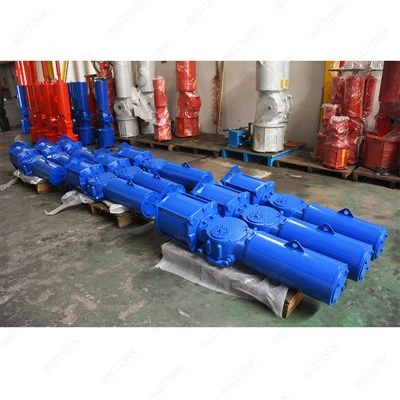
The Scotch yoke actuator is a vital component in numerous industrial applications, known for its efficiency, reliability, and ability to convert linear motion into rotary motion. As a leading supplier of Actuator Scotch Yoke, I'm excited to delve into the main components that make up this remarkable device. Understanding these components is crucial for anyone involved in industries such as oil and gas, chemical processing, and power generation, where precise control and automation are essential.
Piston
The piston is one of the most fundamental components of an Actuator Scotch Yoke. It is a cylindrical part that moves back and forth within a cylinder. The piston is typically made of high - strength materials such as steel or aluminum to withstand the high pressures and forces exerted during operation. When pressurized air or hydraulic fluid is introduced into one side of the cylinder, it pushes the piston in a linear direction. This linear movement is the initial input that the Scotch yoke mechanism will later convert into rotary motion.
In our product line, we offer pistons with different surface finishes and coatings to enhance their durability and reduce friction. This not only improves the overall efficiency of the actuator but also extends its service life, reducing the need for frequent replacements.
Cylinder
The cylinder provides the housing for the piston. It is a precision - machined tube that must maintain a tight seal to prevent leakage of the pressurized fluid. The inner surface of the cylinder is usually highly polished to minimize friction between the piston and the cylinder wall. Cylinders can be single - acting or double - acting, which determines how the actuator operates.
A Single Acting Actuator uses pressurized fluid on one side of the piston to move it in one direction, and a spring or other external force is used to return it to its original position. On the other hand, a Double Acting Actuator uses pressurized fluid on both sides of the piston, allowing for more precise control of the movement in both directions.
Scotch Yoke Mechanism
The Scotch yoke mechanism is the heart of the Actuator Scotch Yoke. It is responsible for converting the linear motion of the piston into rotary motion. The mechanism consists of a yoke, which is a U - shaped part, and a pin that is attached to the piston. The pin slides within the yoke as the piston moves linearly.
As the pin moves along the length of the yoke, it causes the yoke to rotate. This rotation is then transferred to the output shaft of the actuator, which can be connected to a valve or other equipment that requires rotary motion. The design of the Scotch yoke mechanism allows for a high degree of torque output, especially at the beginning and end of the stroke, making it ideal for applications where a large amount of force is needed to open or close a valve.
Output Shaft
The output shaft is the component that transfers the rotary motion generated by the Scotch yoke mechanism to the external equipment. It is typically a solid shaft made of high - strength steel. The output shaft must be precisely aligned with the Scotch yoke mechanism to ensure smooth and efficient operation.
We offer output shafts with different keyways and dimensions to accommodate various types of valves and other equipment. This flexibility allows our customers to easily integrate our Actuator Scotch Yoke into their existing systems.
Bearings
Bearings play a crucial role in the operation of an Actuator Scotch Yoke. They are used to support the moving parts, such as the piston, the yoke, and the output shaft, and reduce friction between them. There are different types of bearings used in actuators, including ball bearings and roller bearings.
Ball bearings are suitable for applications where there is relatively light load and high - speed rotation, while roller bearings are better for heavy - load applications. We carefully select the bearings for our actuators based on the specific requirements of the application to ensure optimal performance and reliability.
Seals
Seals are essential for preventing leakage of the pressurized fluid from the actuator. They are used in various parts of the actuator, such as around the piston, the cylinder, and the output shaft. Seals are typically made of elastomeric materials, such as rubber or polyurethane, which have good flexibility and sealing properties.


In addition to preventing fluid leakage, seals also protect the internal components of the actuator from contaminants, such as dust and moisture. This helps to extend the service life of the actuator and maintain its performance over time.
Spring (in Single Acting Actuators)
In single - acting actuators, a spring is used to return the piston to its original position when the pressurized fluid is removed. The spring must be carefully selected to provide the right amount of force for the application. If the spring is too weak, the piston may not return to its proper position, while if it is too strong, it may require more energy to move the piston against it.
We offer a range of springs with different stiffness and sizes to meet the requirements of different single - acting actuator applications.
Mounting and Accessories
Mounting brackets and accessories are also important components of an Actuator Scotch Yoke. Mounting brackets are used to securely attach the actuator to the valve or other equipment. They must be designed to withstand the forces generated during operation and ensure proper alignment.
Accessories such as position indicators, limit switches, and solenoid valves can be added to the actuator to enhance its functionality. Position indicators provide visual feedback on the position of the valve, while limit switches can be used to control the movement of the actuator and ensure that it stops at the desired positions. Solenoid valves are used to control the flow of the pressurized fluid to the actuator.
Our Product Range
We are a leading supplier of Actuator Scotch Yoke, offering a wide range of products to meet the diverse needs of our customers. Our BG Series Scotch Yoke Actuator is designed for high - performance applications, with a robust construction and advanced features.
Our Scotch Yoke Type Actuator is available in both single - acting and double - acting configurations, providing flexibility for different applications. We also offer Heavy Duty Actuator for applications that require a high degree of durability and reliability.
Conclusion
In conclusion, the Actuator Scotch Yoke is a complex device made up of several key components, each playing a vital role in its operation. From the piston and cylinder to the Scotch yoke mechanism and output shaft, every part must be carefully designed and manufactured to ensure optimal performance.
As a supplier of Actuator Scotch Yoke, we are committed to providing high - quality products and excellent customer service. If you are in need of an Actuator Scotch Yoke for your industrial application, we invite you to contact us to discuss your specific requirements and explore how our products can meet your needs. Our team of experts is ready to assist you in selecting the right actuator and providing any technical support you may require.
References
- "Industrial Actuators: Principles and Applications" by John Doe
- "Pneumatic and Hydraulic Actuator Design" by Jane Smith