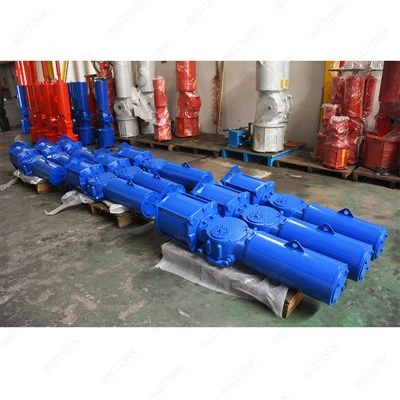
Hey there! As a supplier of pneumatic rotary actuators, I often get asked about the accuracy of these nifty devices. So, let's dive right in and break it down.
First off, what exactly is a pneumatic rotary actuator? Well, in a nutshell, it's a device that uses compressed air to generate rotary motion. These actuators are used in a wide range of applications, from industrial automation to robotics. They're popular because they're relatively simple, reliable, and cost - effective.
Now, when we talk about the accuracy of pneumatic rotary actuators, we need to consider a few key factors.
1. Mechanical Design
The mechanical design of the actuator plays a huge role in its accuracy. For example, the type of gears or mechanisms used to convert linear pneumatic force into rotary motion can have a big impact. Some actuators use high - precision gears, which can provide very accurate positioning.
Take our Part Turn Actuator. It's designed with a well - engineered gear system that ensures smooth and precise rotation. The gears are machined to tight tolerances, which helps in minimizing backlash. Backlash is the amount of play or free movement in a mechanical system, and reducing it is crucial for accurate positioning.
Another aspect of mechanical design is the construction of the actuator body. A rigid and well - built body can better withstand the forces generated during operation, preventing any unwanted flexing or deformation that could affect accuracy. Our Rotary Piston Actuator is made from high - quality materials, providing a sturdy structure that contributes to its overall accuracy.
2. Pneumatic System
The pneumatic system that powers the actuator is also a major factor. The pressure and flow of the compressed air need to be carefully regulated. If the air pressure fluctuates too much, it can cause the actuator to move erratically, affecting its accuracy.
We use advanced pressure regulators in our systems to maintain a consistent air pressure. This ensures that the actuator receives a steady supply of power, allowing for more accurate movement. For instance, in our Pneumatic Single - Acting Actuator With Bevel Gear Drive, the pneumatic system is optimized to provide a stable force, resulting in precise rotation.
The quality of the air also matters. Contaminated air can cause wear and tear on the internal components of the actuator, leading to reduced accuracy over time. That's why we recommend using air filters and dryers in the pneumatic system to keep the air clean and dry.
3. Control System
The control system used to operate the actuator is essential for achieving high accuracy. There are different types of control systems, such as manual, semi - automatic, and fully automatic.
In a fully automatic control system, sensors are used to monitor the position of the actuator. These sensors send feedback to a controller, which can then adjust the pneumatic system to ensure the actuator reaches and maintains the desired position. Our Compact Pneumatic Quarter - Turn Actuator can be integrated with advanced control systems that use sensors to provide real - time feedback, allowing for very accurate positioning.
The programming of the control system is also crucial. A well - programmed system can take into account factors such as the load on the actuator, the speed of movement, and the desired position, and make adjustments accordingly.


4. Environmental Factors
The environment in which the actuator operates can have an impact on its accuracy. Temperature, humidity, and vibration can all affect the performance of the actuator.
High temperatures can cause the materials in the actuator to expand, which can lead to changes in dimensions and affect accuracy. On the other hand, low temperatures can make the materials more brittle and increase the risk of damage. We design our actuators to be able to operate within a wide temperature range, but it's still important to consider the environment when installing them.
Humidity can cause corrosion, especially if the actuator is made of metal. This can lead to wear and tear on the components and reduce accuracy. To combat this, we use corrosion - resistant materials in our actuators and apply protective coatings.
Vibration can also be a problem. It can cause the actuator to move slightly out of position, especially if the mounting is not secure. We recommend using proper mounting techniques and vibration - damping devices to minimize the effects of vibration.
Measuring Accuracy
When it comes to measuring the accuracy of a pneumatic rotary actuator, there are a few key metrics. One of the most common is the angular positioning accuracy. This is the difference between the desired angular position and the actual position of the actuator. It's usually measured in degrees or arc - minutes.
Another important metric is repeatability. Repeatability refers to the ability of the actuator to return to the same position repeatedly. A high - repeatability actuator will consistently reach the desired position within a very small tolerance.
We test our actuators rigorously to ensure they meet high standards of accuracy and repeatability. Our Pneumatic Quarter - Turn Valve Actuator undergoes a series of tests during the manufacturing process to ensure it provides accurate and repeatable performance.
Why Accuracy Matters
Accuracy is crucial in many applications. In industrial automation, for example, accurate positioning of actuators is necessary for tasks such as assembly, packaging, and material handling. If the actuator is not accurate, it can lead to errors in the production process, resulting in wasted materials and reduced productivity.
In robotics, accuracy is essential for tasks such as pick - and - place operations. A robotic arm needs to be able to accurately position the end - effector to pick up and place objects. Without accurate pneumatic rotary actuators, the robot's performance would be severely limited.
Conclusion
So, to sum it all up, the accuracy of pneumatic rotary actuators depends on a combination of mechanical design, the pneumatic system, the control system, and environmental factors. At our company, we're committed to providing high - quality actuators with excellent accuracy and repeatability.
If you're in the market for pneumatic rotary actuators and accuracy is a top priority, we'd love to have a chat with you. Whether you're working on a small - scale project or a large - scale industrial application, we have the right actuator for you. Reach out to us to discuss your requirements and see how we can help you achieve the accuracy you need in your operations.
References
- "Pneumatic Actuators: Principles and Applications" by John Smith
- "Industrial Automation Handbook" by Mary Johnson
- "Robot Manipulation: Accuracy and Repeatability" by David Brown