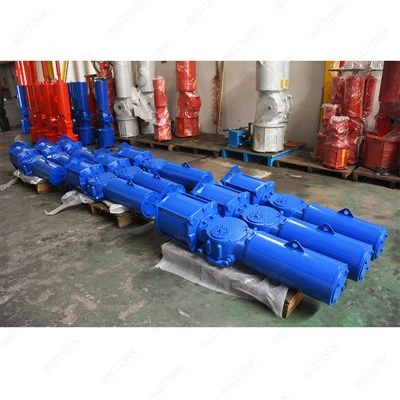
In the world of industrial automation and fluid control systems, Scotch Yoke Type Actuators stand out as reliable and efficient components for operating valves. As a well - established supplier of Scotch Yoke Type Actuators, I am frequently asked about the installation space requirements for these devices. Understanding these requirements is crucial for engineers, plant managers, and technicians to ensure a seamless integration of the actuators into their systems.
Understanding Scotch Yoke Type Actuators
Before delving into the installation space requirements, let's briefly understand what a Scotch Yoke Type Actuator is. A Scotch Yoke Type Actuator is a mechanical device that converts linear motion into rotary motion. It consists of a piston that moves linearly within a cylinder, and a yoke mechanism that transfers this linear motion to a rotating shaft. This design allows for high torque output at specific angles of rotation, making it ideal for operating quarter - turn valves such as ball valves, butterfly valves, and plug valves.
There are two main types of Scotch Yoke Type Actuators: single - acting and double - acting. Single - acting actuators, like the ones on our Single Acting Actuator page, use air pressure to move the piston in one direction and a spring to return it to the original position. Double - acting actuators, as described on the Double Acting Actuator page, use air pressure to move the piston in both directions. Additionally, we offer Air Actuator options that are powered by compressed air, providing a clean and efficient source of power.
Factors Affecting Installation Space Requirements
Actuator Size and Model
The physical dimensions of the actuator are the most obvious factor influencing the installation space. Larger actuators, such as our P350 Double - Acting Scotch Yoke Actuator, require more space compared to smaller models. These dimensions include the length, width, and height of the actuator body, as well as the extension of any rods or shafts.
When selecting an actuator, it is essential to refer to the manufacturer's dimensional drawings. These drawings provide precise measurements of the actuator, including the mounting holes, shaft dimensions, and any additional protrusions. By comparing these dimensions with the available space in the installation area, you can determine if the actuator will fit.
Valve Connection and Mounting
The type of valve connection and mounting also affects the installation space. Scotch Yoke Type Actuators are typically mounted on the valve stem, and the connection method can vary. Some actuators use a direct flange connection, while others may require an adapter kit. The mounting orientation can also impact the space requirements. For example, a vertically mounted actuator may require less floor space but more vertical clearance, while a horizontally mounted actuator may need more lateral space.
In addition to the direct mounting area, there should be enough space around the actuator for maintenance and inspection. This includes access to the control valves, air supply lines, and any other associated components. A rule of thumb is to leave at least 10 - 15 cm of clearance around the actuator to allow for easy access.


Air Supply and Control Lines
The installation of air supply and control lines is another aspect that needs to be considered. These lines need to be routed in a way that does not interfere with the operation of the actuator or other equipment in the area. The length and diameter of the lines, as well as the number of fittings and valves, can all affect the space requirements.
For proper functioning, the air supply lines should be installed with sufficient slack to accommodate any movement of the actuator. Additionally, there should be enough space to install and operate any pressure regulators, filters, and lubricators in the air supply system. These components are essential for maintaining the performance and longevity of the actuator.
Surrounding Equipment and Environment
The presence of other equipment in the vicinity of the actuator can also impact the installation space. For example, if there are pipes, electrical panels, or other machinery nearby, the actuator may need to be installed in a way that avoids collisions or interference. In some cases, it may be necessary to relocate or reconfigure the surrounding equipment to create enough space for the actuator.
The environmental conditions at the installation site can also play a role. In areas with high humidity, dust, or corrosive substances, additional protection may be required for the actuator. This could include installing enclosures or protective covers, which will add to the overall space requirements.
Calculating the Installation Space
To calculate the installation space for a Scotch Yoke Type Actuator, follow these steps:
- Determine the Actuator Dimensions: Refer to the manufacturer's specifications for the length, width, and height of the actuator. Include any additional dimensions for the shaft, rods, or other protrusions.
- Consider the Mounting Requirements: Account for the space needed for mounting the actuator on the valve. This includes the space for the mounting bolts or flanges and any adapter kits.
- Add Space for Maintenance and Inspection:Leave sufficient clearance around the actuator for maintenance and inspection purposes. This is typically around 10 - 15 cm on all sides.
- Factor in the Air Supply and Control Lines: Calculate the space required for routing the air supply and control lines. Consider the length, diameter, and number of fittings.
- Account for Surrounding Equipment and Environment: If there are other equipment nearby or if special environmental protection is needed, add the necessary space to the calculations.
Real - World Examples
Let's consider a real - world scenario where a P350 Double - Acting Scotch Yoke Actuator is to be installed on a large - diameter butterfly valve in an industrial plant. The actuator has a length of 60 cm, a width of 40 cm, and a height of 30 cm. The mounting flange requires an additional 5 cm of space on each side.
For maintenance and inspection, we need to leave 15 cm of clearance around the actuator. The air supply and control lines will be routed along one side of the actuator, requiring an additional 20 cm of space. There is a pipe located 30 cm away from the proposed installation site, so we need to ensure that the actuator does not interfere with it.
Based on these requirements, the total installation space needed would be approximately (60 + 15 + 15) cm in length, (40+ 5+5 + 15+15) cm in width, and (30 + 15+15) cm in height. This calculation takes into account all the factors mentioned above and ensures that the actuator can be installed and operated safely and efficiently.
Conclusion
Understanding the installation space requirements for a Scotch Yoke Type Actuator is essential for a successful installation. By considering factors such as actuator size, valve connection, air supply lines, and the surrounding environment, you can accurately calculate the space needed and avoid any potential issues during installation.
As a leading supplier of Scotch Yoke Type Actuators, we are committed to providing our customers with high - quality products and comprehensive technical support. If you are in the process of selecting an actuator for your application or need assistance with installation space calculations, please do not hesitate to contact us. Our team of experts is ready to help you make the right choice and ensure a seamless integration of our actuators into your system. Let's start the conversation and find the best solution for your industrial automation needs.
References
- Manufacturer's documentation for Scotch Yoke Type Actuators
- Industry standards for valve actuator installation
- Engineering handbooks on fluid control systems