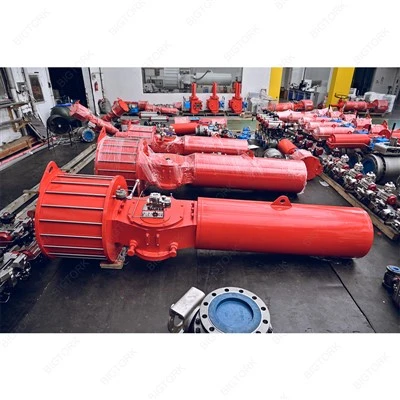
Yo, what's up everyone! As a supplier of scotch yoke actuators, I often get asked about the stiffness of these cool devices. So, today, I'm gonna break down what the stiffness of a scotch yoke actuator really means and why it's so important in various applications.
First off, let's talk about what a scotch yoke actuator is in case you're not familiar. It's a type of Air Actuator that converts linear motion into rotational motion. This mechanism is commonly used in valves and other industrial equipment to control the flow of fluids or gases.
Now, the stiffness of a scotch yoke actuator refers to its ability to resist deformation when a force is applied. In simpler terms, it's like how well a spring can hold its shape when you push or pull on it. A stiffer actuator will maintain its position more accurately and respond better to changes in load.
There are a few factors that can affect the stiffness of a scotch yoke actuator. One of the main ones is the material used in its construction. Actuators made from high - strength materials like steel or aluminum tend to have higher stiffness compared to those made from softer materials. For example, our BG Series Scotch Yoke Actuator uses top - quality steel, which gives it excellent stiffness and durability.
The design of the actuator also plays a huge role. The way the mechanical components are arranged and connected can either enhance or reduce the overall stiffness. A well - designed scotch yoke actuator will have a rigid structure that minimizes flexing and ensures smooth operation. Our engineers have spent a lot of time optimizing the design of our Scotch Yoke Valve Actuator to achieve the best stiffness possible.
Another factor is the size of the actuator. Generally, larger actuators tend to be stiffer because they have more material to resist deformation. However, it's important to choose the right size for your specific application, as a too - large actuator can be overkill and a too - small one won't provide enough stiffness.
So, why is stiffness so important? Well, in applications where precise control is required, such as in a chemical processing plant or a power generation facility, the stiffness of the actuator can directly impact the performance of the entire system. A stiff actuator can ensure accurate valve positioning, which is crucial for maintaining the correct flow rate and pressure of the fluids or gases.
For instance, if you're using a Double Acting Actuator to control the opening and closing of a valve in a pipeline, a lack of stiffness could cause the valve to move slightly out of position, leading to leaks or inconsistent flow. This can be a major headache and even pose safety risks in some cases.
In addition, a stiffer actuator can also improve the response time of the system. When a change in load occurs, a stiff actuator can quickly adjust its position without any significant delay. This is especially important in applications where rapid changes are common, like in an automated manufacturing process.
Let's take our P350 Double - Acting Scotch Yoke Actuator as an example. It's designed to have high stiffness, which allows it to respond quickly to changes in pneumatic pressure. This results in faster valve operation and better overall system performance.
When it comes to measuring the stiffness of a scotch yoke actuator, there are a few methods. One common way is to apply a known force and measure the resulting displacement. The ratio of the force to the displacement gives you the stiffness value. However, this can be a bit tricky in real - world applications, as the load and operating conditions can vary.
We at our company take stiffness very seriously. We conduct rigorous testing on all of our actuators to ensure they meet the highest standards. Our quality control team uses advanced equipment to measure the stiffness and other performance parameters. This way, we can guarantee that our customers get actuators that are reliable and effective.
If you're in the market for a scotch yoke actuator, stiffness should definitely be one of the factors you consider. Don't just go for the cheapest option or the one with the flashiest features. Make sure the actuator has the right level of stiffness for your specific application.
And that's where we come in. As a supplier, we have a wide range of scotch yoke actuators with different stiffness levels to meet the diverse needs of our customers. Whether you need a small actuator for a delicate control system or a large one for heavy - duty industrial applications, we've got you covered.
If you're interested in learning more about our products or need help choosing the right actuator for your project, don't hesitate to reach out. We're always here to answer your questions and provide you with the best solutions. Let's have a chat and see how we can work together to make your operations more efficient and reliable.
References


- "Industrial Actuators Handbook"
- "Fluid Control Systems: Principles and Applications"