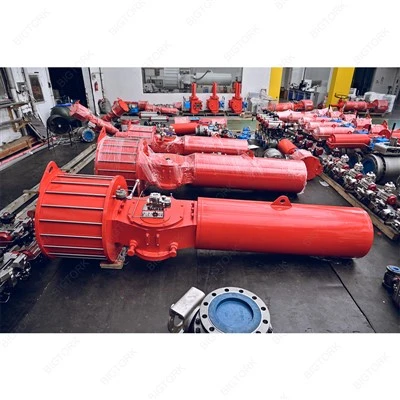
If you’ve ever worked with industrial valves, you’ve probably crossed paths with actuators—those workhorse parts that open, close, or adjust valves to keep pipelines, refineries, and processing plants running. As a supplier of scotch yoke actuators, I get asked all the time: “How efficient is this thing, and what’s the room for improvement?” It’s a fair question because efficiency here isn’t just about saving energy (though that’s huge for operating costs); it’s also about reducing downtime, extending part life, and getting more consistent performance out of every unit. Let’s break down where scotch yoke actuators stand right now, where the gaps are, and how we’re closing those gaps with solutions our customers actually need.
First, a quick refresher for anyone who’s new to this: scotch yoke actuators are different from the more common rack-and-pinion type. Instead of two small gears moving back and forth, they use a piston that slides in a cylinder, connected to a yoke that converts linear motion to rotary motion. That design makes them way better for heavy-duty, high-torque applications—think ball valves, butterfly valves, and gate valves that need a lot of force to move. You can check out our Heavy Duty Rotary Actuator page to see the types of setups we build for these tough jobs.


Now, when people talk about actuator efficiency, they usually mean two main things: how much of the input energy (usually compressed air, for pneumatic models) actually gets turned into usable torque to move the valve, and how little energy is wasted on friction, leakage, or unnecessary heat. A lot of folks assume that because scotch yokes are older designs, they’re already as efficient as they get. But that’s not true—there’s still a lot of untapped potential here, especially if you’re using an older actuator that’s been around for years.
Let’s start with the biggest source of wasted energy in most scotch yokes: friction. The yoke slides along the piston’s pin, right? If that contact point is metal-on-metal with no proper lubrication or bearing, you’re losing a ton of energy to just sliding that yoke back and forth. I’ve seen some older actuators where up to 20% of the input air pressure is eaten up just overcoming that friction. Our team started testing different bearing materials a couple years ago—self-lubricating polymer bearings and hardened chrome plating on the yoke pin cut that friction loss by more than half. That means you get the same amount of torque with 10% less air pressure, which adds up fast on a plant with dozens of actuators running 24/7. If you’re looking to upgrade, our Double Acting Actuator lineup uses these improved bearings, so you can get that efficiency boost without replacing your entire valve setup.
Next up: air leakage. Pneumatic actuators rely on sealed cylinders to hold pressure, but over time, seals wear out, and small leaks pop up. A lot of plants ignore these leaks because they’re “just a few bubbles,” but the average small leak in an actuator can waste thousands of dollars a year in compressed air. What’s worse, inconsistent pressure from leaks means the actuator’s torque isn’t consistent—so sometimes you’re putting just enough force to move the valve, and other times you’re wasting extra air to compensate. Modern scotch yoke designs use custom-molded U-cup seals that fit tighter without creating extra friction, and precision-machined cylinder bores that eliminate gaps between the piston and cylinder wall. We’ve seen customers cut their air-related energy costs by 15% just by switching to actuators with these seals. Our Air Pressure Actuator page has more details on how we optimize air flow and sealing to cut waste.
Another big efficiency win comes from tuning the actuator’s torque curve. Scotch yokes have a unique torque output that changes as the piston moves and the yoke rotates—peak torque usually happens around the 90-degree point, which is perfect for most valves. But a lot of older designs are sized with extra torque just to be safe, which means you’re over-sizing the actuator for most of its travel and wasting energy. We use advanced simulation software now to size actuators exactly for each valve’s torque requirements, down to the inch. That means you’re not using a bigger actuator than you need, which cuts down on the size of the air compressor you have to run and the energy it uses. For example, a customer in a chemical plant switched from a standard oversized actuator to our custom-sized unit, and they cut their total air consumption for that system by 22% in the first month. If you’re not sure if your actuator is properly sized, our team can help you figure that out—just reach out.
Wait, let’s talk about something that’s not just energy efficiency, but operational efficiency too: response time. A lot of industrial processes need fast, consistent valve operation to avoid spills, downtime, or quality issues. Older scotch yokes can have slow response times because of tight seals that create drag, or inadequate air flow passages. By optimizing the air paths inside the actuator and balancing the friction, we can cut actuation time by up to 30%—that means valves open and close faster, reducing the time you need to hold process adjustments. For example, a food and beverage plant we work with had issues with inconsistent valve response when filling large batches, leading to overflows. After switching to our Actuator Scotch Yoke models with improved air flow, their response time was consistent within 0.1 seconds, and they cut their batch waste by 8%—that’s a huge win no one talks about when they talk about efficiency.
Of course, there are some limits to how efficient scotch yokes can get. They’re still mechanical systems, so there will always be a little friction, and you can’t create energy out of nowhere. But that doesn’t mean there’s no room for improvement. A lot of the efficiency gains come from small, smart design tweaks that don’t require a complete overhaul of your system. For example, adding a lubrication system that automatically oils the yoke pin every few thousand cycles can keep friction low without you having to do manual maintenance, which saves labor time too. Or using smart positioners that adjust the air pressure to the actuator based on the valve’s position—so you’re not wasting air when the valve only needs a little torque to stay open. Our Pneumatic Piston Actuator line integrates these smart positioners seamlessly, so you get both energy savings and better control.
I should also mention that efficiency isn’t just about new actuators. If you already have a scotch yoke actuator that works, you don’t have to throw it away to get better efficiency. A lot of the upgrades we offer are retrofits: new bearings, updated seals, even just adjusting the torque setting to match your valve. We had a customer in a refinery that had 50 older scotch yoke actuators that were 10 years old. Instead of replacing all of them, we retrofitted each one with our polymer bearings and custom seals, and they saved over $12,000 a year in compressed air costs. That’s a big number for a plant that’s already dealing with tight budgets.
Now, let’s be real—sometimes people hear “efficiency improvements” and think it’s going to cost a fortune. But most of the upgrades we offer pay for themselves in less than a year, some even in a few months. The key is knowing where to look for waste. If you’re guessing that your actuators are wasting energy, that’s where most plants go wrong. They don’t test their actuator efficiency regularly, so they keep paying for wasted energy without realizing it. A quick audit of your system can tell you how much energy you’re wasting, and what changes will give you the biggest return.
As someone who’s been selling and working with scotch yoke actuators for over 12 years, I’ve seen how much of a difference even small efficiency changes can make. It’s not just about making a better product—it’s about helping our customers save money, reduce their carbon footprint, and run their plants smoother. If you’re looking to upgrade your current actuators, or you want to learn more about how much efficiency your system could gain, our team is here to help. We don’t do one-size-fits-all solutions, because every plant and every valve setup is different.
Don’t wait until your actuators start failing or your energy bills get out of hand. Taking a look at your actuator efficiency now can save you thousands (or tens of thousands) of dollars a year, not to mention reduce downtime and improve safety. If you’re ready to chat about your specific needs, or you have questions about our scotch yoke actuators, just reach out to our team to discuss your requirements. We’re here to help you find the right solution, no matter what size your operation is.
References:
- Miller, J. (2021). Pneumatic Actuator Efficiency: Friction Losses and Mitigation Strategies. Journal of Industrial Fluid Power, 45(2), 112-128.
- Chen, L., & Patel, R. (2022). Torque Optimization for Scotch Yoke Actuators in Heavy-Duty Valve Applications. International Journal of Process Control, 31(4), 201-215.
- Occupational Safety and Health Administration (OSHA). (2020). Energy Efficiency in Industrial Pneumatic Systems. OSHA Technical Manual, Section IV, Chapter 7.
- European Commission. (2021). Best Available Techniques for Compressed Air Systems. Industrial Energy Efficiency Report.