If you’ve ever stood in a processing plant, watched a valve snap open or closed with precise, reliable force, chances are you’ve been in the presence of an air actuator. As a supplier who’s spent years engineering and delivering these critical components to facilities across industries—from oil and gas pipelines to food and beverage processing—I’ve learned that an air actuator’s performance lives or dies by its communication interfaces. These are the “conversational links” between the actuator, the valve it operates, and the control system that dictates process flow; skimp on choosing the right interfaces, and even the sturdiest air actuator will underperform, leading to costly downtime, misaligned processes, or safety risks. Today, I want to walk through the core communication interfaces that define how air actuators interact with their environments, share real-world lessons I’ve learned working with clients, and highlight the solutions our team offers to match every operational need.


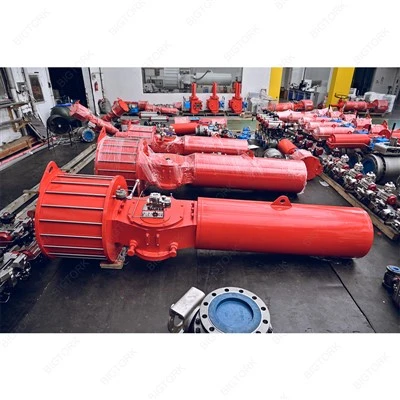
First, it helps to ground this conversation in what an air actuator actually does, because its communication interfaces are tailored to that function. Unlike electric actuators that rely on voltage signals, air (or pneumatic) actuators use compressed air to generate rotary or linear motion—most often to open or close valves that regulate fluid, gas, or slurry flow. Among the most common designs we provide are the Scotch Yoke Valve Actuator, a workhorse for heavy rotary valves that delivers high torque for quarter-turn operations. What makes this design flexible is its ability to adapt to different control systems, which starts with its primary communication interface: pneumatic signal interfaces.
Pneumatic signal interfaces are the oldest and still most widely used communication method for air actuators, especially in explosive or harsh environments where electric signals could pose a safety hazard. These interfaces use compressed air pressure (measured in PSI, typically 3–15 PSI for standard control) to transmit commands from a control valve (like a solenoid valve or a pressure regulator) to the actuator. For example, a 3 PSI signal might tell the Scotch Yoke Valve Actuator to close a valve, while a 15 PSI signal tells it to open. This interface is simple, robust, and requires little specialized training to install, which is why it’s still the go-to for many remote or hazardous-site applications. But it’s not without limits: pneumatic signals can’t send data beyond basic on/off or open/close commands, so you can’t monitor things like actuator position or air supply pressure in real time. That’s where other interfaces come in.
As industries have moved toward digital process automation, electronic communication interfaces have become essential for clients who need real-time visibility into their equipment. The most ubiquitous electronic interface for air actuators is the analog 4–20 mA current loop, an industry standard that’s been around for decades. This interface converts process variables—like actuator stem position, air pressure, or temperature—into a continuous 4–20 mA signal. A 4 mA signal usually means the actuator is at its closed position, while 20 mA means it’s fully open; values in between tell you its exact position, which is perfect for applications requiring precise flow regulation, like chemical blending or pharmaceutical manufacturing. The key benefit here is that analog signals are less susceptible to electrical noise than voltage signals, making them reliable for longer cable runs, often up to 1,000 feet or more. That said, like pneumatic signals, 4–20 mA is a one-way communication system for most basic setups—you can send a command to the actuator, but you can’t always configure it remotely or get detailed diagnostic data beyond its position.
To solve that limitation, we’ve seen a huge shift toward digital communication interfaces, which enable two-way data exchange between actuators and control systems. The most common digital protocol for pneumatic actuators today is HART (Highway Addressable Remote Transducer), which sits on top of the 4–20 mA analog signal, combining the best of both worlds. A HART-enabled actuator can send not just position data, but also diagnostic information: how much air it’s using, whether internal seals are wearing out, or if the supply pressure is dropping below safe levels. This data is game-changing for predictive maintenance, because it lets clients catch small issues before they lead to unplanned shutdowns. For example, a food processing plant we worked with last year used HART interfaces on their Heavy Duty Rotary Actuators to monitor torque levels over time; when we noticed a gradual increase in torque readings during routine data checks, we scheduled a seal replacement during a planned shutdown, avoiding an estimated $50,000 in lost production from an unplanned outage.
Another digital protocol that’s growing in popularity is Profibus, especially for manufacturing plants that use Siemens control systems. Profibus offers faster data transfer rates than HART, supporting larger networks of actuators and other devices, making it ideal for large-scale processing facilities with hundreds of valves. We also support Foundation Fieldbus, a protocol common in oil and gas and refining, where reliability and interoperability with legacy systems are critical. For clients building new automated facilities, digital interfaces are non-negotiable, because they integrate seamlessly with modern distributed control systems (DCS) and industrial IoT (IIoT) platforms, turning their air actuators from simple motion devices into smart components of a connected operation.
Beyond these digital and analog interfaces, there are two other critical communication interfaces that often get overlooked but are essential for installation and operation: manual and auxiliary interfaces. Manual interfaces are the local controls on the actuator itself—usually a handwheel or a mechanical lever—that let operators override automatic commands in case of a control system failure. This is a non-negotiable safety feature for every air actuator we provide; even the most advanced smart actuator needs a way to be operated locally, especially in emergency situations. For example, during a power outage at a wastewater treatment plant, the control system might lose pneumatic and electric signals, so manual operation of the actuator is the only way to shut off a valve and prevent a spill.
Auxiliary communication interfaces are the add-ons that extend the actuator’s functionality, including limit switches and position transmitters. Limit switches are small electronic (or mechanical) devices that send a binary signal—on or off—when the actuator reaches its fully open or fully closed position. They’re often used to trigger alarms or activate other process steps, like sounding a notification when a valve is closed or logging a flow event. Position transmitters, which work with either analog or digital interfaces, send continuous data about the actuator’s exact position, even when it’s between full open and full closed. For our actuator scotch yoke models, we offer customizable limit switch housings and position transmitters that fit seamlessly, whether the client needs a basic mechanical limit switch for a small process or a smart position transmitter that integrates with IIoT platforms.
I should also mention double acting actuators, a common design we supply, and how their interfaces are tailored to their operation. Double acting actuators use compressed air on both sides of the piston to move it in both directions, so they require two separate pneumatic signal lines—one to extend and one to retract the actuator. For these models, our Double Acting Actuator pages detail how we configure pneumatic and electronic interfaces to support this dual-action operation, ensuring smooth, consistent motion even for high-cycle applications like pipeline valves that open and close thousands of times a year. The interface here has to be precise, because a misaligned signal could cause the actuator to jam or apply too much torque, damaging the valve or the actuator itself.
Working in this industry for years, I’ve seen firsthand how choosing the right communication interface isn’t just a technical detail—it’s a strategic decision that impacts uptime, safety, and operational costs. A client that only needs basic on/off control for a small water valve might get by with a simple pneumatic interface, saving them upfront costs. A large refining facility, on the other hand, will need digital HART or Profibus interfaces to monitor hundreds of actuators and comply with safety regulations. That’s why our team doesn’t just sell actuators; we work with clients to assess their specific needs, from their control system setup to their operational environment, and recommend the right communication interfaces to match.
If you’re looking to upgrade your existing air actuators or source new ones, or if you have questions about how our interfaces work with your current systems, our team is here to help. We’ve engineered our lines—including the Scotch Yoke Valve Actuator, Heavy Duty Rotary Actuator, and Double Acting Actuator—to integrate with nearly every control system on the market, and we provide full support for installation, configuration, and troubleshooting. Don’t let outdated or incompatible communication interfaces limit your actuator’s performance—reach out today to discuss your requirements, and we’ll help you find the perfect solution for your operation.
References
- Pneumatic Actuator Technology: A Guide to Design, Interfaces, and Applications (2022). Industrial Automation and Control Association.
- “Scotch Yoke Actuators for Quarter-Turn Valves” – AB Automation Technical Report, 2023.
- International Society of Automation (ISA) Standard S50.02: Electrical and Electronic Equipment for Process Control, 2021.
- “Digital Communication Protocols for Industrial Actuators” – Pneumatic Systems and Components Journal, Q3 2022.
- Process Safety and Automation: Best Practices for Valve Actuator Implementation (2023). National Association of Corrosion Engineers (NACE).