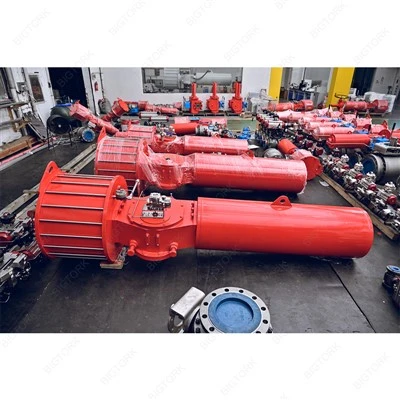
Hey there! I'm in the business of supplying Air Operated Actuators, and today I'm gonna break down how these nifty devices work. Air Operated Actuators, also known as pneumatic actuators, are widely used in various industries, from manufacturing to automation. They play a crucial role in controlling valves and other machinery, and understanding their working principle can help you make better decisions when it comes to purchasing.
Let's start from the basics. An Air Operated Actuator uses compressed air as its power source. Compressed air is a great choice because it's clean, easy to control, and readily available in most industrial settings. The actuator takes this compressed air and converts it into mechanical motion, which can be used to open, close, or adjust a valve or perform other mechanical tasks.
The Core Components
There are a few key components that make up a linear air operated actuator. First, there's the cylinder. This is like the heart of the actuator. It's a hollow tube where the magic happens. Inside the cylinder, there's a piston. The piston is a movable disk that divides the cylinder into two chambers. When compressed air is introduced into one of these chambers, it pushes the piston, creating linear motion.
The ends of the cylinder are sealed with end caps. These end caps not only keep the compressed air inside the cylinder but also provide mounting points for the actuator. They're usually made of strong materials like metal or plastic to withstand the pressure.
Another important part is the rod. The rod is attached to the piston and extends outside the cylinder. As the piston moves inside the cylinder, the rod moves with it, transferring the linear motion to the valve or other equipment that needs to be controlled.
Then, there are the ports. Ports are small openings in the cylinder where the compressed air enters and exits. There are usually two ports: one for the air to enter and push the piston in one direction and another for the air to enter and push the piston in the opposite direction.
The Working Cycle
Now, let's walk through the working cycle of a linear air operated actuator. It all begins when the control system sends a signal to a valve, which then directs the compressed air into one of the ports of the actuator.
Let's say the air is directed into the port on one side of the piston. The compressed air fills that chamber, creating pressure. This pressure pushes the piston towards the other side of the cylinder. As the piston moves, the rod attached to it also moves in a straight line. This linear motion can be used to open a valve, move a robotic arm, or perform other tasks.
Once the piston reaches the end of its travel, the control system can reverse the process. It sends a signal to the valve to direct the compressed air into the other port. The air now fills the other chamber, creating pressure on the opposite side of the piston. This pressure pushes the piston back to its original position, and the rod moves back accordingly.
Some actuators are designed to be "single-acting." In a single-acting actuator, the compressed air is used to move the piston in one direction, and a spring is used to return the piston to its original position. This is useful in applications where you only need to move the actuator in one direction most of the time.
On the other hand, "double-acting" actuators use compressed air to move the piston in both directions. This gives you more control and flexibility, and they're suitable for applications where you need to move the actuator back and forth frequently.
Types of Linear Air Operated Actuators
There are different types of linear air operated actuators, each with its own advantages and suitable applications.
- Valve Actuator Air: These are specifically designed to control valves. They can be used to open and close valves in pipelines, regulating the flow of liquids or gases. They come in different sizes and force ratings, depending on the requirements of the valve.
- Compressed Air Valve Actuator: Similar to the valve actuator air, but they are optimized for applications where high-pressure compressed air is used. They are built to handle the strong forces generated by the compressed air and are often used in industrial processes where precise control of high-pressure valves is required.
- Air Piston Actuator: These actuators use a piston to convert the energy of the compressed air into linear motion. They are simple in design, reliable, and can provide high force output. They are commonly used in machinery and automation systems where linear motion is needed.
- Industrial Pneumatic Actuators: This is a broad category that includes all types of pneumatic actuators used in industrial settings. They are designed to be durable and reliable, able to withstand the harsh conditions of industrial environments. They can be used in a wide range of applications, from manufacturing to transportation.
Applications
The applications of linear air operated actuators are vast. In the manufacturing industry, they're used in production lines to control the movement of conveyor belts, robotic arms, and other equipment. They can be programmed to perform repetitive tasks with high precision, improving efficiency and reducing the risk of human error.
In the energy sector, they're used to control valves in pipelines, ensuring the safe and efficient flow of oil, gas, and other fluids. They can also be used in power plants to control the opening and closing of steam valves, regulating the power output.
In the automotive industry, they're used in the assembly process to install components, such as engines and transmissions. They can provide the necessary force and precision to perform these tasks accurately.
Advantages of Using Linear Air Operated Actuators
There are several advantages to using linear air operated actuators. First of all, they're relatively inexpensive compared to other types of actuators, such as electric or hydraulic actuators. They also require less maintenance since they have fewer moving parts.


They're fast-acting, which means they can respond quickly to control signals. This is important in applications where rapid movement is required.
They're also clean. Since they use compressed air as their power source, there's no risk of oil spills or other contaminants, making them suitable for applications where cleanliness is a concern, such as the food and pharmaceutical industries.
Considerations When Choosing an Actuator
When choosing a linear air operated actuator for your application, there are a few things to consider. First, you need to determine the force requirements. How much force do you need to move the valve or equipment? The size and type of actuator will depend on the force requirements.
You also need to consider the stroke length. The stroke length is the distance the piston can travel inside the cylinder. It should be long enough to accommodate the movement required for your application.
The speed of the actuator is another important factor. How fast do you need the actuator to move? Some actuators are designed for high-speed applications, while others are better suited for slow and precise movements.
The environment in which the actuator will be used is also crucial. If it will be exposed to harsh conditions, such as high temperatures, corrosive chemicals, or dusty environments, you need to choose an actuator that is designed to withstand these conditions.
Conclusion
So, there you have it! That's the working principle of a linear air operated actuator in a nutshell. These devices are simple yet powerful, and they play a vital role in many industries. If you're in the market for an air operated actuator, or if you have any questions about how they work and which one is right for your application, feel free to reach out. We're here to help you make the best choice and ensure that your equipment runs smoothly.
References
- "Pneumatic Actuators Handbook," [Author's Name], Publisher [Publisher's Name], [Year of Publication].
- "Industrial Automation: Principles and Applications," [Author's Name], Publisher [Publisher's Name], [Year of Publication].