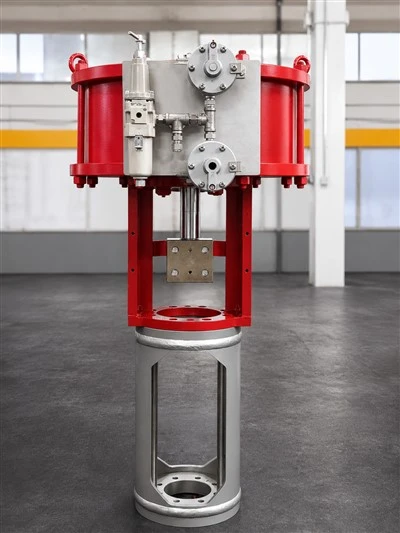
A scotch yoke actuator is a mechanical device that converts linear motion into rotational motion, or vice versa. It is widely used in various industrial applications, especially in valve actuation systems. As a scotch yoke actuator supplier, I understand the importance of the kinematic analysis of this device, which helps in optimizing its design, performance, and reliability.
Basic Structure of a Scotch Yoke Actuator
Before delving into the kinematic analysis, it's essential to understand the basic structure of a scotch yoke actuator. A typical scotch yoke actuator consists of a piston, a yoke, and a crank. The piston moves linearly within a cylinder, driven by a fluid (usually air or hydraulic oil). The yoke is connected to the piston and has a slot that engages with a pin on the crank. As the piston moves linearly, the yoke transfers this motion to the crank, which rotates about its axis.
Kinematic Variables
In the kinematic analysis of a scotch yoke actuator, we are primarily concerned with three variables: displacement, velocity, and acceleration. These variables describe the motion of the piston and the crank at different points in time.
Displacement
The displacement of the piston is the linear distance it travels within the cylinder. The displacement of the crank is the angular distance it rotates about its axis. The relationship between the linear displacement of the piston ($x$) and the angular displacement of the crank ($\theta$) can be derived from the geometric configuration of the scotch yoke mechanism.
Let $r$ be the radius of the crank (distance from the center of rotation to the pin), and $L$ be the length of the stroke of the piston. When the crank rotates through an angle $\theta$, the linear displacement of the piston is given by the formula:


$x = r\sin\theta$
This formula shows that the linear displacement of the piston is a sinusoidal function of the angular displacement of the crank. The maximum displacement of the piston occurs when $\sin\theta = 1$, i.e., $\theta = 90^{\circ}$ or $\theta = 270^{\circ}$, and is equal to the radius of the crank.
Velocity
The velocity of the piston is the rate of change of its displacement with respect to time. The velocity of the crank is the rate of change of its angular displacement with respect to time. To find the velocity of the piston, we differentiate the displacement equation with respect to time.
Using the chain - rule, if $x = r\sin\theta$, then $\frac{dx}{dt}=r\cos\theta\frac{d\theta}{dt}$
Let $v$ be the linear velocity of the piston and $\omega$ be the angular velocity of the crank. Then $v = r\omega\cos\theta$
This equation shows that the linear velocity of the piston is also a sinusoidal function of the angular displacement of the crank. The maximum velocity of the piston occurs when $\cos\theta = 1$, i.e., $\theta = 0^{\circ}$ or $\theta = 360^{\circ}$, and is equal to $r\omega$.
Acceleration
The acceleration of the piston is the rate of change of its velocity with respect to time. Differentiating the velocity equation with respect to time, we get:
$\frac{dv}{dt}=-r\omega^{2}\sin\theta$
Let $a$ be the linear acceleration of the piston. Then $a=-r\omega^{2}\sin\theta$
The negative sign indicates that the acceleration is in the opposite direction of the displacement when $\sin\theta> 0$. The maximum acceleration of the piston occurs when $\sin\theta = 1$ or $\sin\theta=- 1$, i.e., $\theta = 90^{\circ}$ or $\theta = 270^{\circ}$, and is equal to $r\omega^{2}$.
Applications of Kinematic Analysis
The kinematic analysis of a scotch yoke actuator has several important applications:
Design Optimization
By understanding the relationships between displacement, velocity, and acceleration, engineers can optimize the design of the scotch yoke actuator. For example, they can choose the appropriate crank radius and stroke length to achieve the desired rotational motion and torque output. They can also design the actuator to operate within the desired speed and acceleration limits, reducing wear and tear on the components.
Performance Evaluation
Kinematic analysis helps in evaluating the performance of the scotch yoke actuator under different operating conditions. Engineers can use the equations to predict the motion of the actuator at different crank angles and angular velocities. This information can be used to determine the actuator's response time, torque output, and power consumption.
System Integration
When integrating the scotch yoke actuator into a larger system, such as a valve control system, kinematic analysis is crucial. It allows engineers to ensure that the actuator's motion is synchronized with the requirements of the system. For example, in a valve actuation system, the actuator must open and close the valve within a specific time interval and with the appropriate torque.
Our Scotch Yoke Actuator Offerings
As a scotch yoke actuator supplier, we offer a wide range of high - quality actuators, including Scotch Yoke Valve Actuator. Our actuators are designed with precision, taking into account the kinematic principles discussed above.
We also provide Air Actuator, which uses compressed air as the driving force. These air actuators offer fast and efficient operation, making them suitable for applications where quick response is required.
Our Air Torque Actuator is designed to provide high torque output, ensuring reliable operation even in demanding environments. The kinematic design of these actuators is optimized to deliver maximum torque at the desired crank angles.
Our Scotch Yoke Type Actuator is a versatile solution that can be customized to meet the specific requirements of different applications. Whether you need a small - scale actuator for a laboratory experiment or a large - scale actuator for industrial use, we have the perfect solution for you.
We also offer Double Acting Actuator, which can provide both forward and reverse motion. The double - acting design allows for more precise control of the valve position, making it ideal for applications where accurate positioning is crucial.
Conclusion
The kinematic analysis of a scotch yoke actuator is a fundamental aspect of its design, performance evaluation, and system integration. By understanding the relationships between displacement, velocity, and acceleration, engineers can optimize the actuator's performance and ensure its reliable operation.
As a scotch yoke actuator supplier, we are committed to providing high - quality actuators that are designed based on the latest kinematic principles. If you are in the market for a scotch yoke actuator, we invite you to contact us to discuss your specific requirements and explore how our products can meet your needs. Our team of experts is ready to assist you in finding the best solution for your application.
References
- Norton, Robert L. "Machine Design: An Integrated Approach." Pearson, 2012.
- Shigley, Joseph E., et al. "Mechanical Engineering Design." McGraw - Hill, 2016.