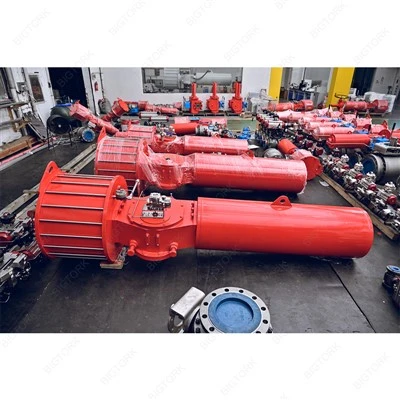
How to synchronize multiple pneumatic rotary actuators?
In the industrial automation landscape, pneumatic rotary actuators play a pivotal role in converting compressed air energy into rotational motion. They are utilized in a wide array of applications, from controlling valves to operating robotic arms. When the task at hand demands the coordinated movement of multiple pneumatic rotary actuators, achieving synchronization becomes a crucial challenge. As a trusted supplier of [product link], we are committed to providing solutions that ensure seamless and efficient synchronization.
Understanding the Basics of Pneumatic Rotary Actuators
Before delving into the synchronization methods, it's essential to understand the different types of pneumatic rotary actuators available in the market. These include the Angular Actuator, Rotary Piston Actuator, Actuator with Bevel Gear Manual Override, Part Turn Actuator, and Large Bore Spring Return Actuator. Each type has its own unique characteristics and applications, which can influence the synchronization strategy.
The Angular Actuator provides precise angular rotation and is suitable for applications requiring accurate positioning. The Rotary Piston Actuator, on the other hand, offers high torque output and is ideal for heavy-duty tasks. The Actuator with Bevel Gear Manual Override allows for manual operation in case of emergencies or maintenance, adding an extra layer of safety. The Part Turn Actuator is designed for applications that require a partial rotation, such as valve control. Lastly, the Large Bore Spring Return Actuator provides a reliable spring return mechanism, ensuring the actuator returns to its original position in the event of a loss of air pressure.
Challenges in Synchronizing Multiple Pneumatic Rotary Actuators
Synchronizing multiple pneumatic rotary actuators comes with its own set of challenges. One of the primary challenges is the variability in actuator performance. Even if the actuators are of the same type and model, there can be slight differences in their manufacturing tolerances, which can lead to variations in their speed and torque output. Additionally, factors such as air pressure fluctuations, friction, and wear and tear can also affect the performance of the actuators, making it difficult to achieve precise synchronization.
Another challenge is the control system complexity. Coordinating the movement of multiple actuators requires a sophisticated control system that can independently adjust the air pressure, flow rate, and timing of each actuator. Developing and implementing such a control system can be a daunting task, especially for complex applications with a large number of actuators.
Methods for Synchronizing Multiple Pneumatic Rotary Actuators
1. Mechanical Linkage
One of the simplest methods for synchronizing multiple pneumatic rotary actuators is through mechanical linkage. This involves physically connecting the actuators together using gears, belts, or chains. By linking the actuators, they are forced to move in unison, ensuring that they rotate at the same speed and angle.
Mechanical linkage is a reliable and cost - effective method for synchronization, especially for applications where the actuators are located in close proximity to each other. However, it has its limitations. The mechanical components can introduce additional friction and wear, which can affect the performance and lifespan of the actuators. Additionally, the mechanical linkage may not be suitable for applications where the actuators need to be independently controlled or where there are space constraints.
2. Pneumatic Control
Pneumatic control is another commonly used method for synchronizing multiple pneumatic rotary actuators. This involves using a pneumatic valve system to control the air pressure and flow rate to each actuator. By adjusting the air pressure and flow rate, the speed and torque of each actuator can be regulated, allowing for precise synchronization.
Pneumatic control systems can range from simple on - off valves to more complex proportional valves. Proportional valves offer greater control over the actuator performance, as they can adjust the air pressure and flow rate in proportion to an input signal. This allows for more precise synchronization, even in applications with varying load conditions.
However, pneumatic control systems are also susceptible to air pressure fluctuations and leaks, which can affect the synchronization accuracy. regular maintenance and monitoring of the pneumatic system are required to ensure optimal performance.
3. Electronic Control
Electronic control is the most advanced method for synchronizing multiple pneumatic rotary actuators. This involves using sensors to monitor the position, speed, and torque of each actuator and a programmable logic controller (PLC) to regulate the air pressure and flow rate based on the sensor feedback.
The sensors provide real - time data on the actuator performance, allowing the PLC to make adjustments as needed to ensure precise synchronization. Electronic control systems offer several advantages, including high accuracy, flexibility, and the ability to handle complex synchronization tasks. They can also be easily integrated with other automation systems, such as industrial robots and conveyors.
However, electronic control systems are more expensive and complex to implement compared to mechanical and pneumatic methods. They also require specialized knowledge and skills for programming and maintenance.
Best Practices for Synchronizing Multiple Pneumatic Rotary Actuators
1. Actuator Selection
The first step in achieving successful synchronization is to select the right actuators for the application. Consider factors such as the required torque, speed, and rotation angle, as well as the operating environment. Choose actuators that are of high quality and have consistent performance characteristics.
2. System Design
A well - designed system is essential for effective synchronization. Pay attention to the layout of the actuators, the routing of the pneumatic lines, and the placement of the control components. Minimize the length of the pneumatic lines to reduce pressure drops and ensure uniform air distribution.
3. Regular Maintenance
Regular maintenance is crucial to keep the actuators and the synchronization system in good working condition. This includes inspecting the actuators for wear and tear, checking the air pressure and flow rates, and cleaning or replacing the filters.


4. Testing and Calibration
Before putting the synchronized system into operation, it is important to conduct thorough testing and calibration. This involves verifying the accuracy of the sensors, adjusting the control parameters, and testing the system under different load conditions.
Conclusion
Synchronizing multiple pneumatic rotary actuators is a complex but achievable task. By understanding the different types of actuators, the challenges involved, and the available synchronization methods, you can choose the best approach for your application. Whether you opt for mechanical linkage, pneumatic control, or electronic control, following the best practices outlined above will help you achieve reliable and efficient synchronization.
As a leading supplier of pneumatic rotary actuators, we have the expertise and experience to assist you in selecting the right actuators and developing a synchronization solution that meets your specific needs. If you are interested in learning more about our products or discussing your synchronization requirements, please feel free to contact us. We look forward to the opportunity to work with you and contribute to the success of your industrial automation projects.
References
- [Author's Surname, Name]. [Title of the Book]. [Publisher], [Year of Publication].
- [Author's Surname, Name]. "[Title of the Article]." [Name of the Journal], Vol. [Volume Number], No. [Issue Number], [Year of Publication], pp. [Page Range].
- [Name of the Organization]. [Title of the Report]. [Organization], [Year of Publication].