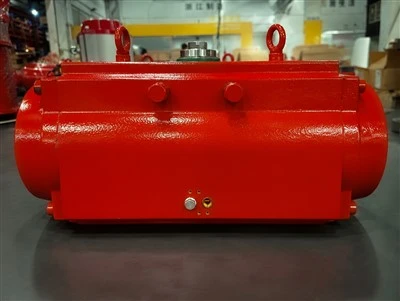
The working process of hydraulic actuators can be divided into the following stages: receiving signals, controlling execution, and feedback status.
Firstly, hydraulic actuators need to receive signals from external control systems, which can be electrical signals or other forms of signals. The actuator controls internal components such as valves or motors based on the type and magnitude of the signals. This stage is mainly achieved through components such as sensors or switches, which convert external signals into instructions that can be recognized by the actuator.
Next, the internal valves or motors of the actuator control the output of power sources such as compressed air, hydraulic oil, or electrical energy based on the received signals, achieving parameter control of mechanical equipment's motion, position, and force. This stage is the embodiment of the core function of the actuator, which achieves precise control of external equipment through the internal mechanical structure and hydraulic system.
Finally, the sensors or switches inside the actuator provide feedback to the control system based on parameters such as the motion, position, and force of the mechanical equipment, and send signals to achieve closed-loop control. This stage ensures that the operation of the actuator can be executed accurately according to the preset instructions, and the execution effect is continuously adjusted and optimized through feedback mechanism.